Maryana Gogol is a product development chemist with five years of experience in the Consumer Products department at Stepan Company, including formulation expertise across personal care and hard surface care applications. She holds a bachelor’s degree in biochemistry from Loyola University in Chicago and is dedicated to developing high-quality products while continuously advancing her expertise in the field.

Unlocking Conditioner Performance: Advanced Instrumental Methods
By Maryana Gogol, Chemist - Consumer Products, Stepan Company

The landscape of hair care products is rapidly evolving. Conditioners are no longer expected to simply provide basic conditioning benefits. There is a growing demand for substantiated claims and demonstrable functional efficacy, driven by both regulatory expectations and consumer sophistication. As a result, brands and manufacturers are seeking advanced, data-driven approaches to validate product performance and differentiate their offerings in a competitive market.
Stepan Company applies advanced instrumental methodologies to support brands and manufacturers in developing conditioners that deliver measurable performance and substantiated claims. The following overview presents key technologies and analytical strategies used to quantify gloss, control frizz, and improve combability, providing formulators with actionable data for product innovation and positioning
Quantifying Shine with SAMBA Hair
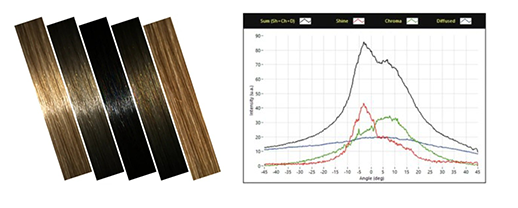
The visual appeal of hair, particularly its shine, is a central focus in conditioner formulation. The SAMBA Hair system from Bossa Nova Vision is utilized to objectively measure hair gloss. This technology employs a specialized camera with polarized light, capturing three distinct images: specular reflection (shine), chroma (color), and diffuse light. The software generates quantitative metrics such as BNT and Reich-Robbins values, which serve as reliable indicators for gloss claims.
Comparative analysis of untreated and conditioned hair tresses is performed by separating shine, chroma, and diffuse components, resulting in a graph of shine angle. A narrow, intense peak on this graph signifies strong shine, aligning with visual perception of glossy hair. These measurements enable precise optimization of conditioner performance by evaluating treatments on identical hair swatches. Stepan integrates these results into product development, ensuring that conditioners formulated for brands and manufacturers achieve targeted shine attributes supported by robust data.
Frizz and Volume Analysis with BOLERO 360 and SHUFFLE
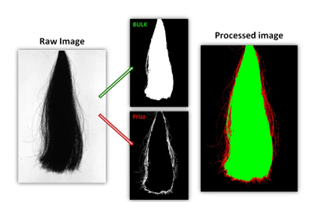
Frizz and fly-away fibers present significant formulation challenges. The SHUFFLE platform, equipped with the BOLERO 360 attachment, provides comprehensive three-dimensional analysis of hair volume and frizz. The BOLERO 360 rotates the hair tress, capturing images from 36 angles to construct a detailed 3D model that distinguishes bulk hair from fly-away fibers.
Processed images and quantitative data reveal both total hair volume and the specific contribution of frizz. Reduction in the red-marked frizz area demonstrates the effectiveness of anti-frizz conditioners. Stepan leverages these insights to refine formulations and supply brands and manufacturers with compelling, data-backed evidence for product claims. This approach ensures that conditioners developed through Stepan’s process deliver smoother, more manageable hair validated by advanced instrumental analysis.
Combability Testing with Dia-Stron
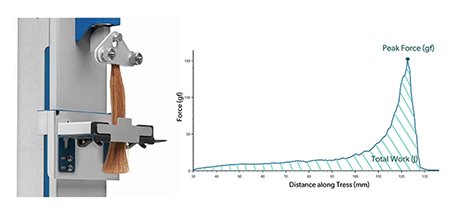
Combability is a critical parameter for conditioner efficacy. The Dia-Stron system is employed to measure the force required to comb treated hair tresses. During testing, a sensor records the force along the length of the hair as a comb is drawn through. The highest force, or peak force, is a key metric; lower peak force indicates improved combability.
The resulting force-versus-distance graph, with the shaded area under the curve representing total work, provides a clear visualization of combing effort. Effective conditioners produce lower peak force and reduced total work, translating to easier combing and less pulling. These measurements are incorporated into Stepan’s product development process, enabling brands and manufacturers to substantiate combability claims with rigorous, instrument-based data.
Translating Instrumental Data into Formulation Insights
The instrumental methods described—shine testing with SAMBA, frizz and volume analysis with BOLERO 360, and combability testing with Dia-Stron—form the foundation of Stepan’s innovative approach to conditioner development. By integrating these technologies into research and development, Stepan generates clear, actionable data that bridges laboratory results and real-world product performance.
This data-driven process supports brands and manufacturers in creating conditioners that meet specific performance targets and consumer expectations. Instrumental analysis not only substantiates product claims but also guides formulation strategies, ensuring that conditioners deliver measurable benefits in gloss, frizz control, and combability. Stepan’s commitment to innovation and technical excellence empowers partners to advance their hair care portfolios with confidence.

Maximize Your Formula’s Potential: Guidance from Stepan Experts
Whether you’re just starting or refining your formula, Stepan Personal Care has the resources to help. We’ve documented our expertise into the Hair Conditioners Formulation Guide that provides detailed information on everything formulators need — from ingredient functions and formula parameters to an ingredient decision tree designed to simplify the selection process.